Monthly Archives: September 2012

Curso A.2.1 – ¿Qué estudiamos en este curso? 2/2

Tras realizar el post 1/2 Curso A.2.1. En este Post completo la información sobre la gramática. Dentro de la gramática a estudiar en este curso intensivo esta:

La unión de adjetivos y sustantivos para la formación de palabras: Großvater- Das ist der Großvater von Petra / Das ist Petras Großvater.

Los artículos posesivos en Dativ (añadiendo -em, -er, -em, -en …sust -n)

Los pronombres personales en Nominativo, Acusativo (complemento directo) y Dativo (complemento indirecto).

Los pronombres reflexivos en acusativo.

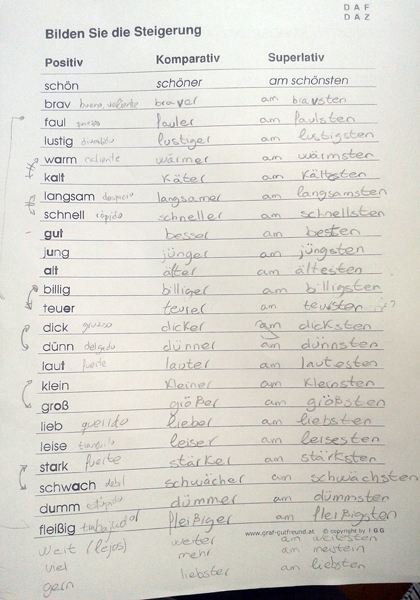
Frases con comparativos: so …wie/als, construcción de comparativos schwer, -er, am  …-sten, der/die/das …-ste.
Adjetivos en Dativ, regla: Adjetive im Dativ mit Artikel: Die Endung ist immer-en.

Frases indefinidas con niemand, wenige, vielle y alle.

Los verbos modales: en especial sollen „deberías“ ( es importante recordar que los verbos modales no se pueden utilizar en frases imperativas).

Z.B: Klaus hat gerade angerufen. Du sollst inh vom Bahnhof abholen.
 

Curso A.2.1 – ¿Qué estudiamos en este curso? 1/2

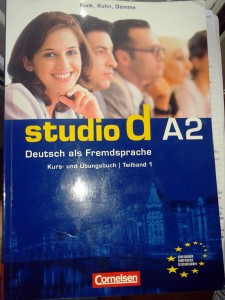
El libro utilizado es de la editorial Cornesen, título „Studio D A2“ – Teilband 1. No es necesario buscarlo en tiendas ya que lo tienen a la venta en la oficina de la academia. Las clases se complementan con las fotocopias de ejercicios y gramática entregados por el profesor.

En este nivel aprenderéis a realizar frases compuestas con weil (porque): Ich habe English gelernt, weil es ein Schulfach war.

Frases compuestas (relativas) con dass (que): Ich meine, dass Auto zu teuer ist.

Preguntas indirectas ob (si): Ich habe gefragt, ob du am Wochenende kommst?

Con wann, wo, ….: Ich möchte wissen, wann du kommst?

Frases relativas y nominativas en acusativo (complemento directo) y sus reglas: Das ist ein Kuchen, den man zu Weihnachten backt.

Frases unidas con aber: Eine Reise mit dem Zug dauert länger als mit dem Flugzeug, aber sie ist bequemer.

Preguntas con oder: Gehen wir zu dir oder zu mir?


Aktiv in der Freizeit + Reflexivpronomen

Entre la clase de ayer y la de hoy hemos estudiado las „Aktiv in der Freizeit“, actividades para el tiempo libre y hemos aprendido los Reflexivpronomen:

ich =>mich , du =>dich, er/es/sie => sich, wir=>uns, ihr=> euch , sie/Sie => sich.

Ejercicio con Reflexivpronomen: Ich muss mich noch schminken. Hast du dich schon rasiert?.

La primera hora hemos estado hablando cada uno de nosotros de nuestras aficiones, el futbol, la pesca, la F1, el Yoga, correr, etc… Por el motivo que fuera hoy hemos sido únicamente 5 personas en clase, esto obliga a que exista una gran fluidez en la clase. En mi curso pienso que estamos avanzando bastante en la comunicación verbal y continuando a la vez con las gramática programado para el mes.


Learning Audio Course German

Before going to the DeutschAkademie, studied German myself, with several books of grammar exercises, reading books like „Aladdin und die Wunderlampe“ (with only 4 or 5 pages) and a computer program. But you always have the doubt of whether I’m pronouncing it right or if they understand me when I stay alone „versus“ the Austrians.

So here is my recommendation!

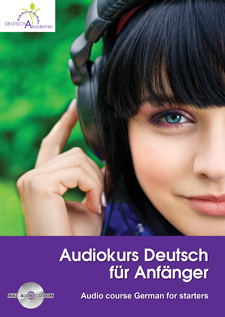
Audio Course German for Starters

It’s a great choice, because while you hear a story, they repeat and translate the most difficult parts.

The audio course that I’m working with now, begins with an introduction to a story, later reviews the specific vocabulary of the topic BEFORE continuing with the dialogue. Thus you review the new vocabulary when you are already acquainted with it.

Now begins the part of grammar explained in English, with examples from history and other new examples. Finally some exercises containing the explained grammar.

As it’s recorded you can listen it while doing other tasks or while going to academy or work. For me it is a great help to learn German.

App Deutschakademie

Dank der Android App namens „Learn German DeutschAkademie“ Übung mit den Konnektoren auf der Klasse gestern.

Es ist sehr einfach zu bedienen, können Sie überall überprüfen und ist kostenlos!

En el apartado de los ejercicios, están dividos por niveles (A1, A2, B1, etc) que a su vez se clasifican por los temas de gramática, de esta manera no tienes excusa para practicar los temas un poco más complicados.

Cada tema tiene 10 preguntas tipo test donde después de responder te aparece la respuesta marcada y la correcta, por lo que puedes saber en todo momento si lo estás haciendo correctamente. (¡El ejercicio de números del nivel A1 es muy divertido!)

También puedes consultar ejercicios de un montón de libros (un gran trabajo de recopilación), lecciones de gramática ordenadas alfabéticamente para encontrarlos enseguida, el boletín de noticias, la información sobre los cursos en Berlín, Munich y como no, Viena.

Y para el final os dejo el apartado que más me gusta, el de las estadísticas que te motiva a conseguir una estrella más!!

Bis Morgen!!

Learn German using applications

Through an internet search I found Basic Vocabulary Builder. Several comments finde that Basic Vocabulary Builder is a useful and effective tool developed by DeutschAkademie.

The Basic Vocabulary Builder has 19 chapters, you can download as mp3 files and easily listen when you ride the u-bahn, tram, run or in your free time! The application can be found in the online store DeutschAkademie.

The German Vocabulary is difficult to learn for latins (spanish, South Americans, italian, french, portuguese, …), might have a hard time in trying to memorize german words and verbs that have a root completely different.
The activities are divided by themes such as „School and education“, „public transport“, „home and life“, „city traffic“ …

I also included a printable vocabulary so you have a written copy.

Today I will try and download application, on the blog soon publish my opinion on the application.

They have a mobile app android and iphone very interesting. I have it installed. It allows you to review anywhere.

Deklination der Adjektive


Warning: Undefined array key "file" in /var/www/share/prod-deutschakademie.c-2447.maxcluster.net/htdocs/blog/wp-includes/media.php on line 1723

Typ 1: mit bestimmtem Artikel (der, die, das); auch nach: Demonstrativartikel (diese, jene, derselbe), Fragewort (welche) und Indefinitartikel (jede, alle)

Typ 2: mit unbestimmten Artikel (eine, eine, eines); auch nach: Negationsartikel (kein) und Possessivartikel (mein, dein, sein…)

Typ 3: Nullartikel; auch nach: Zahlen, Indefinitartikel (viel, mehr, wenig, einige, viele, manche, andere), Relativpronomen (dessen, deren)

Typ 3 ist für mich der schwierigste weil ich nicht wusste, bis heute. -> letzter Buchstabe des bestimmten Artikels

MAS     FEM     NEUT

NOM    der      die      das

AKK     den     die      das

DAT     dem    der      dem

GEN   *-EN     der    *-EN

*Ausnahme : GEN maskulin und neutrum -> -en


RELATIV SÄTZE (mein Trick)

Das ist ein komplizierte Thema (für mich)  und ich werde mit eure meine Tricks teilen:

Das Schwierigste zu wissen ist wenn Nominativ, Akkusativ oder Dativ. Hier schreibe ich, wie ich weiß das.


Du bist die Frau, die mich glücklich macht => Wer macht mich glücklich? Immer fragst den zweiter Satz

Wer? Was? => NOM    Die Frau macht mich glücklich


Du bist der Mann, den dich liebe => Wer liebe ich?

Zuerst suchst der Nominativ (Ich). Wenn der Nominativ nicht auf den zweiten Satz zu beantworten, muss es etwas anderes sein (Hier ist mein Trick)

Was? Wer? => AKK     Ich liebe den Mann.


Du bist der Mann, dem ich mein Herz schenke => Wem schenke ich mein Herz?

Wem? => DAT     Ich schenke dem Mann mein Herz


NOM       AKK          DAT

MASK         der         den          dem

FEM           die          die           der

NEUT         das         das          dem

PLUR         die          die          DENEN