Yearly Archives: 2012

Aktiv in der Freizeit + Reflexivpronomen

Entre la clase de ayer y la de hoy hemos estudiado las „Aktiv in der Freizeit“, actividades para el tiempo libre y hemos aprendido los Reflexivpronomen:

ich =>mich , du =>dich, er/es/sie => sich, wir=>uns, ihr=> euch , sie/Sie => sich.

Ejercicio con Reflexivpronomen: Ich muss mich noch schminken. Hast du dich schon rasiert?.

La primera hora hemos estado hablando cada uno de nosotros de nuestras aficiones, el futbol, la pesca, la F1, el Yoga, correr, etc… Por el motivo que fuera hoy hemos sido únicamente 5 personas en clase, esto obliga a que exista una gran fluidez en la clase. En mi curso pienso que estamos avanzando bastante en la comunicación verbal y continuando a la vez con las gramática programado para el mes.

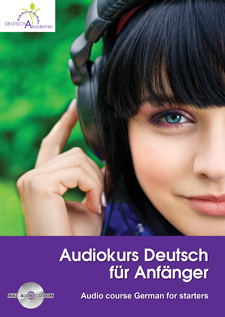


Learning Audio Course German

Before going to the DeutschAkademie, studied German myself, with several books of grammar exercises, reading books like „Aladdin und die Wunderlampe“ (with only 4 or 5 pages) and a computer program. But you always have the doubt of whether I’m pronouncing it right or if they understand me when I stay alone „versus“ the Austrians.

So here is my recommendation!

Audio Course German for Starters

It’s a great choice, because while you hear a story, they repeat and translate the most difficult parts.

The audio course that I’m working with now, begins with an introduction to a story, later reviews the specific vocabulary of the topic BEFORE continuing with the dialogue. Thus you review the new vocabulary when you are already acquainted with it.

Now begins the part of grammar explained in English, with examples from history and other new examples. Finally some exercises containing the explained grammar.

As it’s recorded you can listen it while doing other tasks or while going to academy or work. For me it is a great help to learn German.

App Deutschakademie

Dank der Android App namens „Learn German DeutschAkademie“ Übung mit den Konnektoren auf der Klasse gestern.

Es ist sehr einfach zu bedienen, können Sie überall überprüfen und ist kostenlos!

En el apartado de los ejercicios, están dividos por niveles (A1, A2, B1, etc) que a su vez se clasifican por los temas de gramática, de esta manera no tienes excusa para practicar los temas un poco más complicados.

Cada tema tiene 10 preguntas tipo test donde después de responder te aparece la respuesta marcada y la correcta, por lo que puedes saber en todo momento si lo estás haciendo correctamente. (¡El ejercicio de números del nivel A1 es muy divertido!)

También puedes consultar ejercicios de un montón de libros (un gran trabajo de recopilación), lecciones de gramática ordenadas alfabéticamente para encontrarlos enseguida, el boletín de noticias, la información sobre los cursos en Berlín, Munich y como no, Viena.

Y para el final os dejo el apartado que más me gusta, el de las estadísticas que te motiva a conseguir una estrella más!!

Bis Morgen!!

Learn German using applications

Through an internet search I found Basic Vocabulary Builder. Several comments finde that Basic Vocabulary Builder is a useful and effective tool developed by DeutschAkademie.

The Basic Vocabulary Builder has 19 chapters, you can download as mp3 files and easily listen when you ride the u-bahn, tram, run or in your free time! The application can be found in the online store DeutschAkademie.

The German Vocabulary is difficult to learn for latins (spanish, South Americans, italian, french, portuguese, …), might have a hard time in trying to memorize german words and verbs that have a root completely different.
The activities are divided by themes such as „School and education“, „public transport“, „home and life“, „city traffic“ …

I also included a printable vocabulary so you have a written copy.

Today I will try and download application, on the blog soon publish my opinion on the application.

They have a mobile app android and iphone very interesting. I have it installed. It allows you to review anywhere.

Deklination der Adjektive


Warning: Undefined array key "file" in /var/www/share/prod-deutschakademie.c-2447.maxcluster.net/htdocs/blog/wp-includes/media.php on line 1723

Typ 1: mit bestimmtem Artikel (der, die, das); auch nach: Demonstrativartikel (diese, jene, derselbe), Fragewort (welche) und Indefinitartikel (jede, alle)

Typ 2: mit unbestimmten Artikel (eine, eine, eines); auch nach: Negationsartikel (kein) und Possessivartikel (mein, dein, sein…)

Typ 3: Nullartikel; auch nach: Zahlen, Indefinitartikel (viel, mehr, wenig, einige, viele, manche, andere), Relativpronomen (dessen, deren)

Typ 3 ist für mich der schwierigste weil ich nicht wusste, bis heute. -> letzter Buchstabe des bestimmten Artikels

MAS     FEM     NEUT

NOM    der      die      das

AKK     den     die      das

DAT     dem    der      dem

GEN   *-EN     der    *-EN

*Ausnahme : GEN maskulin und neutrum -> -en


RELATIV SÄTZE (mein Trick)

Das ist ein komplizierte Thema (für mich)  und ich werde mit eure meine Tricks teilen:

Das Schwierigste zu wissen ist wenn Nominativ, Akkusativ oder Dativ. Hier schreibe ich, wie ich weiß das.


Du bist die Frau, die mich glücklich macht => Wer macht mich glücklich? Immer fragst den zweiter Satz

Wer? Was? => NOM    Die Frau macht mich glücklich


Du bist der Mann, den dich liebe => Wer liebe ich?

Zuerst suchst der Nominativ (Ich). Wenn der Nominativ nicht auf den zweiten Satz zu beantworten, muss es etwas anderes sein (Hier ist mein Trick)

Was? Wer? => AKK     Ich liebe den Mann.


Du bist der Mann, dem ich mein Herz schenke => Wem schenke ich mein Herz?

Wem? => DAT     Ich schenke dem Mann mein Herz


NOM       AKK          DAT

MASK         der         den          dem

FEM           die          die           der

NEUT         das         das          dem

PLUR         die          die          DENEN

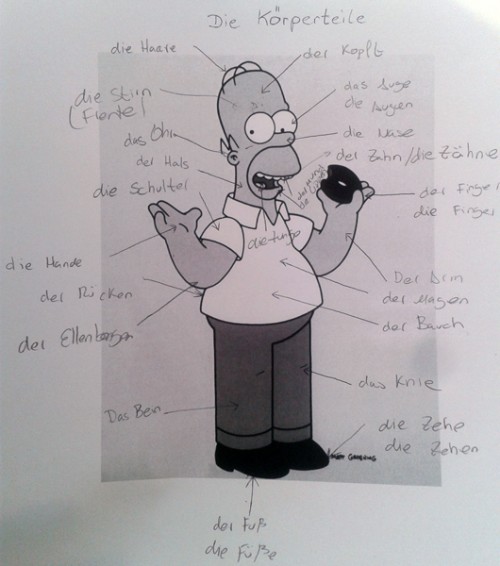
Parts of the body 2+ Imperatives

Photo attached photocopy delivered by Professor.


In the class of yesterday, we explained the imperatives. It is important to know 4 points:

1) In singular: Trinkst du viel! (It is not correct) ==> Trink viel! (It is correct, The verb without st, remove pronoun)

2) In plural: Ihr geht spazieren (affirmative) ==> Geht ihr spazieren! (Imperativ)

3) With the pronoun Sie/sie ==> Seinen Sie brau! (Imperativ)

4) Exception: Singular

essen = Iss! , lesen = Lies! , sein = Sei!

Audio exercises

I’m going to introduce you some ways to prepare your ears to the sound of German language. After some basic grammar knowledge it’s so good to start to how does the German language sounds in real life. From one side you have an audio course at https://www.deutschakademie.de/online-deutschkurs/english/audiokurs. It’s a good way get used to follow short stories with a easy plot depending on your German level. On the other hand, you can listen to the radio or watch TV. On this way you will find much more variety of accents and dialects. Also the speed of the spoken language is quite different than the one on the audio books. For example, it’s not exactly the same to listen to a German language from an Austrian native speaker, than a German or Swiss. The grammar it’s the same, but as all the lanuages, depending on the region you can recognise different words, expressions, accents…

I strongly recommend you to be in contact as much as you can with a real situations, with a real German language. All of as know that grammar rules are necessary, but after a while you have to use the language by your self. It doesen’t matter how many mistakes you do on the daily life or how much do you understand the news on the radio, because little by little that will give you self-confidence to speak in German and don’t be shy for that. However, please don’t misunderstand me, still you have to understand and remember the grammar! 🙂

Deutschakademie: Online Deutschkurs

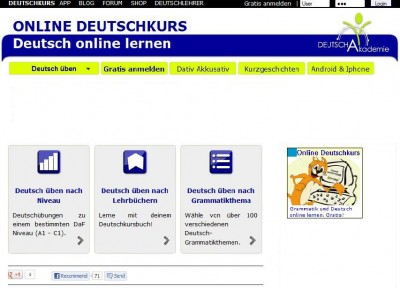
Another option to practice your German skills is the Online Deutschkurs at www.deutschakademie.de/online-deutschkurs. Here you can choose more specificly what do you want to work on it.

– Do you want to practice according to the levels of the Common European Framework of Reference for Languages?
– Do you want to do exercises from the German course books? There is a list of 70 German course books.
– Do you prefer to work on specific grammar topic?

The exercises are multiple choice. You can see if your answer was correct or not and which is the correct answer. At the end of a pack of exercises you can see again all the questions, one after each other with your answer and the correct answer.

This course is also available for Android Smartphones or Tablets. The App is for free, yo can downtload it and do an exercise in the Ubahn, waiting for the S-Bahn or before the Opera play starts!

Why did I choose DeutschAkademie in Vienna?


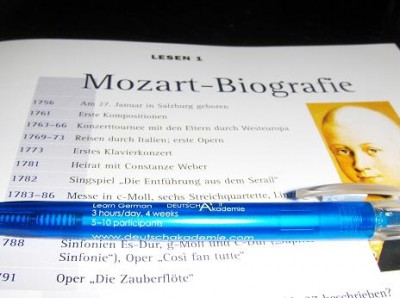
Well, part of the answer is quite easy and obvius. I’m doing a German course in Vienna because I moved to live here! Austrian universities offer a good Master programs. Now remains the answer to “Why did I choose DeutschAkademie?” In Vienna there are a lot of German language schools, but non of them is like DeutschAkademie. As you can see on the picture, their philosophy is straightforward, free from ambiguity. Each course consist of:

– 3 hours/day, 4 weeks

– reduced group (5 to 10 participants)

With one course you have half of a level of a Common European Framework of Reference (CEFR) for languages. It means that with 2 month you can reach one compleate CEFR level. That is a really short period of time.

Another good point of DeutschAkademie is the price: 250 euro/course in Vienna, one of the cheapest ones in Vienna. And the last interesting point is the location: right opposite the Opera, right in the city center.

Der Akkusativ Fall


Today’s tip of Deutsch is one of the most difficult concepts for most of us, beginners in German language: Accusative and Dative cases (or in German “Akkusativ
Fall” and “Dativ Fall”.
When do we have to use which one and what do they mean? If your mother tongue is Spanish, Portuguese, English, Persian (and perhaps Italian, I guess) you might have never heard of theses cases. When ever you need to use an article in your language, you just use it! As simple as that. At most, in languages like Spanish and Portuguese, you have masculine, feminine or neutral articles for nouns. In Persian you don’t even have that (in Persian we treat every one the same!). However this is not the case in German, regarding the role of the noun in a given sentence and regarding the verb of the sentence you need to use different forms of article (and of course concerning the gender of the noun!). The most challenging is Akkusativ and Dativ.
So, let’s go straightly to the point. When ever you have a transitive verb in a sentence, the direct object has to be in Akkusativ form. Dog is “Hund” in German. “Hund” is masculine and needs a masculine article, i.e. “ein”. „I have a dog“ would be translated to German to “Ich habe einen Hund”. That is exactly what happens when an article (masculine) gets the form of Akkusativ: ein → einen, and so on.
Let me explain you in a simpler way. When ever in your sentence, there is an action done directly on the object of the sentence, you have to use Accusative. Let’s try to translate this sentence to German: „There is a man and the dog bite the man“. Do you recognise the “biting” is actually an action done on the (poor) man, so you HAVE to use Akkusativ here: “Es gibt ein Mann, und Der Hund beißt den Mann”. The poor man was directly the object of the action (biting) so we have to use Akkusativ article for him. As easy as that.

About Dativ I have to say that you use it when the object is a receiver. I will give more examples on Dativ in another post

Now I want to mention 2 points here: first of all although I tried to demonstrate the the concept of Akkusativ Fall in German here buy translating from English to German, but translating from one language to another while you are beginner in learning a language is a death trap. You have to avoid it as much as possible. The other point is that as you might already realized, the German grammar is quite complicated and there are many rules in it, so this explanation I gave here is just a very simplistic explanation and you need to rely on the lecture notes and the book you have while you are learning German from your teacher in the class. Don’t forget I am also a beginner and I am just trying to share with you my experience here.

(picture: the solution to bear 3 hour long classes every day: Clever chocolates and fruits in the break)