Es Ist Sophies Schuld!

If your are coming from south of Europe or any where else than central Europe and Germany, perhaps you don’t know any thing about what I am going to talk in this post. Have you noticed the sudden drop in the temperature few days ago here in Vienna. One of my friends told me he heard in news there were some parts of Austria even with -3 degrees!!!!! So the truth to be revealed, Sophie is to be blamed!
I am just kidding, the story is that in the folkloric belief in central Europe (also parts of Balkan,France and the Netherlands), there are saint who are associated with the end of the cold weather that (surprisingly) usually takes place in mid may. More precisely:

11 May: St. Mamertus
12 May: St. Pankratius
13 May: St. Servatius
14 May: St. Bonifatius
15 May: St. Sophie

In German the last one is called “Die Kalte Sophie”. It is believed she brings cold weather with her and centuries ago people used to ask her help for seeds in their farms. Today I heard from an Austria lady at my work that there is an extension to this folkloric belief here: if it rains on the day of “Die Kalte Sophie”, it will keep on raining for 40 days. Thankfully “die Kalte Sophie” is over and we are safe from a 40-day rain.

Next time you are visiting the St. Stephan’c church in Vienna, try to find the column inside the church where St. Sophie is depicted on.

(picture: thermometer in Hietzing metro station showing 12 degrees this morning. Just remember the weather in Vienna 10 days ago !)

I would like to have a cup of coffee please!

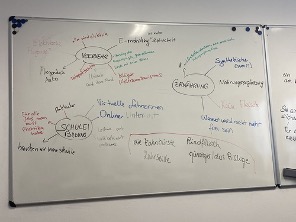
Today we were practicing different forms tenses and modes of sentences with Alex. In the past few weeks, we have learned future tense, the 2 forms of subjunctive and passive. Each time we learned a new tense, we had quite sufficient amount of practice on that specific tense the same day and few following dates. Today out of blue, Alex wanted to check how much of all those exercises we remember. We were all surprised, Alex and all the students. We could remember some of them, but all of us (except Alex, of course) were making mistakes in conjugating some of the verbs. At this point Alex realized although we had learned and practiced those topics recently, but we needed to renew our knowledge again. He decided to write down the more confusing ones on the board and make each of us make an example for them. I thought you also might need to refresh your conjugating skills.
So, the tenses we practiced to day were:
Zukunft: werden + Infinitiv
Perfekt: haben/sein = Partipzip II
Pasiv: werden + Partipzip II
Konjunktiv II Perfekt: hätte/wäre + Partipzip II
Konjunktiv II Präsens: würde + Infinitive

I guess there is no need to explain the first two one. Future and perfect tense are straightforward and easy. Passive is a bit tricky, but it is mostly the same concept in most of the languages. If you know English passive, it is exactly the same concept in German: “Hamlet was written by Shakespeare”.

(picture: Watch out Alex! The Big Brother is watching you!)
And now Konjunktiv II (in English it is called subjunctive mood). There several situations you need to use Konjunktiv II:One way to associate Konjunktiv II Präsens in German to some thing you already know is to think of conditional sentence in English:

If I ate faster, I would surely have a stomachache.

Wenn ich schneller äße, würde ich bestimmt einen Magenschmerz haben.

This sentence is explaining a non-past situation in present or future.
To create the Perfekt (i.e. past) form, we need to use axillary verbs “haben” or “sein”:

If I had eaten faster, I would surely have had a stomachache.

Wenn ich schneller gegesen hätte, hätte ich bestimmt einen Magenschmerz gehabt.

Now it is your turn to find another situation where we need to use Konjunktiv II. How would you ‘politely’ order coffee in a café in Vienna?

Entspanned am Strand

Urlab in Spanien am Strand? Oder Greichland?
Mann kann mich in das bild gestern Abend sehen. Aber weder Spanien, noch Greichlan. Hir in Wien!!!!

Zu viel arbeiten während der Woche und Deutsch kurs jeden Tag… Mann braucht eine Ruhezune um dort zu entspannen. Gehen auf Sand barfuß könnte entspannend, aber wo findet Mann Strand in Wien?
Das is the antwort! „The Sand In the City“ (Der Strand in der Stadt)

Es gibt eine “Chill Out” Platz mitten in Wien heißt „Der Sand in the City“. Es ist neben dem Hotel Continental. Mann kann dorthin mit der Linie U4, Station Landstraße gehen. Dort gibt es einige Bars und Mann kann sein Bier oder Mojito bestellen! Am Ende einer langen Woche, müssen wir die Batterien für den nächsten wiederaufladbaren.Lasst den Spaß nicht entgehen.

Schloss Seggau


Am 7. Mai bin ich mit dem Zug nach Leibnitz gefahren. Reisen in Leibnitz mit dem Zug ist schön, der durch grüne Täler und Berge fährt.

Leibnitz ist im Bundesland Steiremark. Seine Hauptstadt ist Graz. Leibnitz liegt im Süden von Graz, zwischen zwei Flüsse der Mur und der Sulm.

Dort ist ein Campingplatz und das Städtische Bad. Das habt Erlebnisbecken mit Wildwasserkanal, Strand, Schaukelgrotte und Wasserrutschen. Da ist auch eine Minigolfanalge, Leichtathletikanlage mit 400m-Laufbahn, Fußball, Basketball, Beachvolleyball, Tennisplatz, Fitnessmeile, ein Kinderspielplatz und ein W-Lan Hotspot möglich.

Ich übernachtet im Schloss Seggau, das liegt auf dem Seggauberg. Zuerst war es eine Verwaltungsbastion, dann war die Sommerresidenz von dem Bischof. Heute gibt es einen Kongress un ein Seminarzentrum, ein Hotel und ein SchlossCafé. Das Schloss liegt in der Nähe der Stadt. Man kann in einer halben Stunde von das Schloss in die Innenstadt spazieren.

Ich habe die Stadt besucht und ich decke, dass Leibnitz ist eine schöne Stadt.

(Das Bild im Vordergrund: das Rathaus in Leibnitz. Das Bild in der unteren: Die Aussicht von Schloss Seggau)

Der nächste Kurs!

Der A2 Kurs is Vorbei, doch Nächste kurs auf dem weg hierher ist. Ich frage mich was werden wir dann lernen. Im letzten Monat haben wir viele neue Themen gelernt. Diese Themen waren die folgenden:
- Verben in Präteritum (Modalverben, Andere Verben,…)
- Zeitadverbien (damalas, früher, heute, jetzt…)
- Gesprochene VS geschriebene (D.h. Perfekt VS Präteritum)
- Sätze verbindung: denn, weil, wenn, damit
- Das Verb WERDEN (sich forsehen vor der englischen WILL und der  englischen WANT)
- Wünsche-Höflichkeit (z.B. Könntest Du mir die Tasse geben?)
- Dative (Präpositionen und Verben)
- Der Genitive fall!
- Nebensätye: um….zu…..
- Passive: werden/wurden
Alex hat uns viel gelehrt. Er war ein perfekter Lehrer und er machte interessante Übungen für uns. Die meisten Themen in seinen Übungen waren über Österreich und der Politik, und es gefällt mir: Lernen Deutsch und gleichzeitig lernen über Österreich. Ich finde seine Übungen nützlich.

Ich freue mich auf Nächste kurs.

(das Bild: Alex_I:denken, Alex_II:hören und Alex_III:lachen)

Leben ist so Schwer

Ja, das Leben ist so Schwer, auch Deutsch. Dieses Foto hast nach dem Deutschkurs gemacht, bei der Donau. Die sonne scheint mit 30º, so gehen zu der Donau ist nicht ein Möglichkeit, sondern eine Verpflichtung. Hier sind wir, ich und Alvaro mein Spanischer Kollegin von Deutschakademie, mein Angebot von Pizza und Bier war unmöglich zu ablehnen. Ich möchte sagen dass dieser Ort die beste von Wien ist. Wenn wir gut wetter haben, die Donau ist ein Ort wo viele Leute wollen sport machen oder nur entspannen. Ich bin glücklich dass ich lebe fünf minuten von der Donau und ich gehe dort jeden tag.

Ich emphele es zu alle Leute

How I learnt dative or sing to your self: dem dem der


Following the previous post, now let’s take a look at dative case (in German der Dativ Fall). Generally, Dative is used for the indirect object of a sentence. There are certain verbs that you have to use dative case with them in your sentence. Some examples include:
- geben
- schenken
- zeigen
- bringen
- wünchen
- helfen

We can say that usually we have dative case when something is given to some one. For example:
Ich gebe der Frau das Geschenk.
Here clearly an object is given to the lady, there is a physical object being passed to another person. With some verbs, this explanation (giving some thing to some one) is not that clear or at least there is no real physical (tangible) object being exchanged:
Ich helfe dem Mann.
So there is a ‘help’ passed from me to the man, but not a real object.

With some certain prepositions you need to use dative case as well. You have to memorize them, there is no escape from that!
mit, von, zu, nach and aus. Try to memorize one in every few days (if you have not done so yet!). For example from today till the next Monday all the day repeat to your self “I use DATIVE with MIT”. You need to memorize this and use it always. MIT=DATIVE.

After you understood the concept of dative vs accusative (aka direct object vs indirect object) you need to learn the endings of adjectives, articles and personal pronouns in each case.

(picture: possessive articles in dative case in the Deutsch Akadmie’s course book)

Der Akkusativ Fall


Today’s tip of Deutsch is one of the most difficult concepts for most of us, beginners in German language: Accusative and Dative cases (or in German “Akkusativ
Fall” and “Dativ Fall”.
When do we have to use which one and what do they mean? If your mother tongue is Spanish, Portuguese, English, Persian (and perhaps Italian, I guess) you might have never heard of theses cases. When ever you need to use an article in your language, you just use it! As simple as that. At most, in languages like Spanish and Portuguese, you have masculine, feminine or neutral articles for nouns. In Persian you don’t even have that (in Persian we treat every one the same!). However this is not the case in German, regarding the role of the noun in a given sentence and regarding the verb of the sentence you need to use different forms of article (and of course concerning the gender of the noun!). The most challenging is Akkusativ and Dativ.
So, let’s go straightly to the point. When ever you have a transitive verb in a sentence, the direct object has to be in Akkusativ form. Dog is “Hund” in German. “Hund” is masculine and needs a masculine article, i.e. “ein”. “I have a dog” would be translated to German to “Ich habe einen Hund”. That is exactly what happens when an article (masculine) gets the form of Akkusativ: eineinen, and so on.
Let me explain you in a simpler way. When ever in your sentence, there is an action done directly on the object of the sentence, you have to use Accusative. Let’s try to translate this sentence to German: “There is a man and the dog bite the man”. Do you recognise the “biting” is actually an action done on the (poor) man, so you HAVE to use Akkusativ here: “Es gibt ein Mann, und Der Hund beißt den Mann”. The poor man was directly the object of the action (biting) so we have to use Akkusativ article for him. As easy as that.

About Dativ I have to say that you use it when the object is a receiver. I will give more examples on Dativ in another post

Now I want to mention 2 points here: first of all although I tried to demonstrate the the concept of Akkusativ Fall in German here buy translating from English to German, but translating from one language to another while you are beginner in learning a language is a death trap. You have to avoid it as much as possible. The other point is that as you might already realized, the German grammar is quite complicated and there are many rules in it, so this explanation I gave here is just a very simplistic explanation and you need to rely on the lecture notes and the book you have while you are learning German from your teacher in the class. Don’t forget I am also a beginner and I am just trying to share with you my experience here.

(picture: the solution to bear 3 hour long classes every day: Clever chocolates and fruits in the break)

Maifest im Prater


This is a heads up for first of May, “lobar day”. It will be sunny, trust me I checked the forecast a couple of times, and there will be a festival in Prater organized by SPÖ (don’t tell me you don’t know the name of the Austria political parties, at least the reds, one of the oldest ones….Sozialdemokratische Partei Österreichs…), Wiener Kulturservice and Wiener Praterverband. It is called Maifest and will start at 13:00 and will last till night. The interesting part is here: there will be free beer for the first 200 people entering there!

The festival is basically a band contest, and Austrian version. All the bands (around 1000) were competing during the year and just a few of them get to the final which takes place on this day! So you can enjoy the top popular Austrian music (and the beer if you hurry up!)

one suggestion: no matter what is your view on politics or how involved you are in any sort of activities, if you are living in Vienna and learning German, it is good to know some thing about the political parties in Austria/Vienna. At least the names or the abbreviation. It is always a way of practicing German by reading about some general knowledge, let’s say political parties in Austria in wikipedia in German. The text is easy (so it is appropriate for us, the beginners) and you will gain some knowledge. Even if you don”t understand all the words, don’t worry. try to get the most, the sentence structure and the conjugation of the verbs you know.

(picture: don’t try this at home, just try at at Wien Prater!)

kollegin

Vierte Monat und vierte verschiedenen Leute. Hier sind fast alles mein Kollegin von Deutschakademie. Wir sind noch ein mal Irina von Russland, Alvaro von Spanien, Anthony von Canada und Lucie von Tschechische Republik. und die neuen Leute sind fünf frauen. Eine von Puerto Rico (wo bist du Carmen María? du bist die erste 3 tage gekommen, aber wo bist du jetzt),

auch eine andere von Albania, eine Frau von Bulgaria, eine andere von Albanie und ich glaube eine andere von Rumanien, ich bin nicht sicher, immer mit diesen letztem vier Nationalität vergesse ich ein, ich mische sich. Entschuldigung auch für die Namen, für mich ist sehr schwer zu nicht vergesse, ich ziege kein Fehler machen vor, hahaha

Wir haben immer eine tolle Zeit. Und jetzt wird unsere Letzte Woche zusammen aber ich hoffe die nachste Monat mit ihnen vorsetzen